Easter Eggonomics
 Introduction
 Introduction
When walking into a supermarket at this time of year it is impossible not to notice shelves laden with chocolate Easter Eggs. Of course, they deserve their place; as ever, since hitting Victorian shops in 1873 [1] they have proven to be one of the most popular Easter treats, with UK consumers buying approximately 80 million every year [2].
However, behind all the colourful packaging and promises of deliciousness, there is a dark secret – their size has been steadily decreasing over recent years. This is an example of the practice known as “shrinkflation” and in this article we take a look behind the foil wrapper and answer the important question: if this goes on will Easter eggs disappear altogether?
Shrinkflation
First of all, what is Shrinkflation? It occurs when the size of a product decreases, while its price remains the same (or even increases!). It can be considered a type of inflation – hence the name. Suppose in the past you could have bought a chocolate bar weighing 100g for £2, equivalent to £1 per 50g. If the business wanted to increase their profit on it or mitigate against rising costs, they could do two things – increase the price of the bar or decrease its size. If they double the price to £4, or cut the weight to 50g, the effect is the same – your money will only get you half as far, as £1 will only get you 25g of chocolate. The first method is the more well-known version of inflation, but the second method – shrinkflation – is becoming more and more prevalent [3].
One of the reasons for this is that people are far more likely to complain about, and more importantly for a more expensive product. In contrast, a decrease in size might not be immediately apparent to the consumer.
While to the customer this practice appears sneaky and misleading, the companies participating in it offer an alternative view. In the case of Mondelēz, the parent company of Cadbury’s, they point to rising cocoa prices forcing them to reduce the sizes of their products [4]. But our personal favourite example comes from PepsiCo, who reduced the size of their Gatorade bottles but kept the price the same, claiming to be doing so to make the bottles more “aerodynamic” [5].
Easter Egg
Now, the best way to assess shrinkflation (and our original intention) is to compare the price per kg, as then we could see the impact of both inflation and shrinkflation together and truly see if we’re better or worse of. However, finding the prices of Easter Eggs over the years proved to be challenging, and we came up relatively empty handed in our hunt for consistent data. We have therefore decided to just investigate their weights and made the (potentially controversial) assumption that the prices have remained roughly the same over the years.
We also had to decide on what Easter Eggs to look at, after all, manufacturers have been pretty creative over the years. Examples we found during our Easter egg hunt include an egg containing Hot Wheels toys, to a Guinness chocolate Rugby ball, and even a Marmite flavoured Easter Egg (which, love it or hate it, we can all agree that is just plain wrong)! We decided to go more traditional and chose a variety of “large” eggs to look at – namely the Twirl, Wispa, Crème Egg and Crunchie varieties. We chose these eggs simply due to the availability of data and how they’ve remained a consistent part of the Easter line-up over the past decade – there’s nothing to suggest they are any better or worse than their chocolate competitors.
Why not include Dairy Milk, one of the quintessential chocolates in any Easter Bunnies’ basket, you might ask? Surprisingly, the large sized Dairy Milk egg has been retired and replaced by a smaller Dairy Milk buttons egg instead. While this is a flagrant example of shrinkflation, we decided not to include it due to this change. As an aside, the large egg isn’t the only type available – if you spend your free time swimming in a pool of money à la Scrooge McDuck, you might be interested in premium Easter eggs, such as an ‘Ultimate Egg’. This massive Easter egg still has a Dairy Milk option, which weighs 400g and costs £15. To compare, we managed to find the details of the now retired large Dairy Milk egg in 2010 [8] and, outrageously, it weighed 336g and cost only £5 – you really don’t know what you have until it’s gone!
 Example of current large egg on right and older packaging on left.
Weights
Now we have our eggs, we want to figure out how much less we’ve been getting. To answer this, we searched through several articles from 2010 to now and collated all the data we could find relating to our chosen eggs. See [8], [9], [10], [11], [12], [13], [14], [15], [16], [17] and [20]. We then plotted the data points as seen below.

As we can see from the graph, the weights of the Easter egg have been dramatically decreasing over the past decade – shrinkflation is real! All four eggs have seen sharp decreases in their weight over this time period, with the Twirl egg decreasing by 39.8% since 2010, the Wispa egg decreasing by 41.7% over the same period, and the Crème Egg and Crunchie eggs seeing 42.6% and 46.3% decreases respectively between 2018 to now.
Model and Extrapolation
Overall, we are clearly getting significantly less chocolate than we used to and so, we now turn to the question we posed at the start – will Easter eggs disappear forever? And if so, when? To answer this, we performed linear regression and then extrapolated.
Linear regression allows us to investigate the relationship between one or more explanatory variables (in our case, the year) and a response variable (the weight in grams). Despite its name, the relationship found does not necessarily have to be linear, but due to the nature of the data we have only included the linear approach.
We performed this analysis using R. We can see in the table below the linear relationship found between the weight of each egg and time alongside their R2 score. The R2 score is measure of how much of the variance is explained by the model. In our cases, we found really high scores for our relationships, but we have to be careful using this score to say a model is good as we had a very small sample size for each egg.
| Easter Egg | Line | \(R^2\) |
|---|---|---|
| Twirl | \(y=-8.977x + 18,389.409\) | 89.10% |
| Wispa | \(y=-8.530x + 17,466.867\) | 95.58% |
| Crème Egg | \(y=-11.616x + 23,716.575\) | 96.83% |
| Crunchie | \(y=-13.025x + 26,565.264\) | 96.09% |
Using R, we can plot the lines given to us by the linear regression for each of our four eggs, seen below:

Now we have our models, we can try and figure out when the eggs will disappear. As all of our models are straight lines, they have equations of the form:
Where b is the intercept and a is the slope (in our case y will be the weights and x the years). If we set the weight (i.e. y) to be zero, it then becomes easy to rearrange our equations to obtain the year at which this happens. The year when we predict the weight to be zero is then:
As all our slopes are negative, unfortunately we can confirm our Easter eggs will eventually disappear. We predict that the Crunchie Easter egg will be the first to falter, ceasing to exist around 2039, followed by the Crème Egg offering, lasting until the middle of 2041. The Wispa egg valiantly holds on until 2047, leaving the Twirl egg to bow out alone in 2048. They will be missed.
But wait – we can also go back in time! If projecting 25 years into the future wasn’t enough of a faux pas, we could also consider how big Easter eggs were at different points in the past. We chose to look at three key points in time – the launch of the first Easter egg in 1873, the time of the first Easter in roughly 30AD, and when Earth itself formed roughly 4.54 billion years ago (any further back than this would clearly be unreasonable…). Using our linear models from before, we find the following weights:
| Year | |||
|---|---|---|---|
| Easter Egg | 1873AD | 30AD | \(4.54×10^9\)BC |
| Twirl | 1.57kg | 18.1kg | \(4.08×10^7\)kg |
| Wispa | 1.49kg | 17.2kg | \(3.87×10^7\)kg |
| Crème Egg | 1.96kg | 23.4kg | \(5.27×10^7\)kg |
| Crunchie | 2.17kg | 26.2kg | \(5.91×10^7\)kg |
| Average | 1.80kg | 21.2kg | \(4.78×10^7\)kg |

Plot showing the linear regression going back to 1AD, covering our first two points in time.
The average weight of an Easter egg at the dawn of time on Earth is roughly the same as the weight of the Great Wall of China – currently the heaviest human built object on Earth [18]. We wonder if you could see it from space…
Limitations
Now, we do have to caveat our results here – it is highly unlikely chocolate makers would allow their Easter eggs to disappear completely (they’re far more likely just to start putting prices up again!). This highlights there are several limitations with our model as is:
- We introduced selection bias as most of our sources were articles discussing shrinkflation, so they tended to only include instances where weights decreased.
- Following on from this, we have only included the results for our chosen four varieties of eggs and as these were the most abundant in shrinkflation articles, it would suggest that they have seen some of the biggest decreases, leading us to more extreme conclusions.
- We have assumed our trend is linear, when in reality, this is unlikely. This is confirmed by looking at the two eggs which have data points in 2010 – Twirl and Wispa. The gradients of these lines are noticeably shallower, suggesting that shrinkflation has been happening at a much higher rate since 2017/2018 than in the decade preceding it.
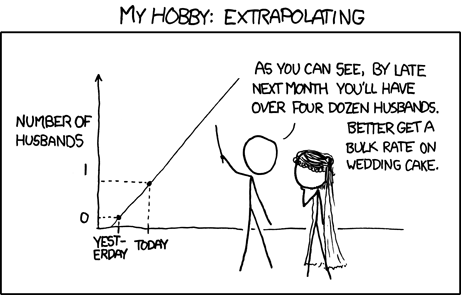
Perhaps extrapolating on limited data doesn’t provide the most sensible conclusions, and perhaps a world where the first easter egg was 2kg doesn’t exist after all – but what a world it would’ve been.
Conclusion
If we’re right, the 2050’s are looking bleak. A time when smashing open chocolate eggs on kitchen countertops is a distant memory. In the future it’s going to be all hot cross buns – we’ll have to wait for our Advent calendars for the holiday chocolate fix.
But maybe it doesn’t have to be this way. Maybe enough people can take notice and let companies know that Easter just wouldn’t be the same if Easter eggs disappear. Well, except for the Marmite one – that can stay gone.
Footnotes
[1] https://www.bbc.co.uk/newsround/17597617
[2] https://www.goodto.com/food/food-news/how-many-easter-eggs-sold-UK-every-year
[3] The Unstoppable Rise of Shrinkflation – The Food Institute
[4] https://www.itv.com/news/2025-01-17/why-your-chocolate-eggs-may-be-more-expensive-this-easter
[5] https://qz.com/2129426/inflation-and-supply-chain-snags-are-shrinking-your-products
[6] https://metro.co.uk/2017/04/08/the-best-supermarket-easter-eggs-including-asda-tesco-sainsburys-and-waitrose-6560917/
[7] https://www.statista.com/statistics/1109990/easter-egg-prices-united-kingdom-grocery-stores/
[8] https://www.lovemoney.com/news/4771/the-massive-easter-egg-ripoff
[9] https://madhousefamilyreviews.blogspot.com/2017/03/weve-been-reviewing-cadbury-easter-2017.html
[10] https://www.manchestereveningnews.co.uk/whats-on/shopping/best-easter-egg-offers-2017-12766764
[11] https://www.dailymail.co.uk/femail/article-6682513/Cadburys-admits-Easter-eggs-smaller-claims-shrink-affordable.html
[12] https://www.thesun.co.uk/money/8380005/cadburys-easter-eggs-size-slashed-shrinkflation/
[13] https://www.derbytelegraph.co.uk/whats-on/food-drink/cadburys-cuts-size-easter-eggs-5251150
[14] https://www.birminghammail.co.uk/whats-on/shopping/easter-egg-delivery-uk-2020-18038166
[15] https://www.dailymail.co.uk/news/article-10702871/Cadburys-Easter-eggs-shrunk-nearly-10-three-years-price-same.html
[16] https://www.thesun.co.uk/money/26871391/easter-eggs-downsized-shrinkflation/
[17] https://www.ft.com/content/02f3475b-3c5f-4685-83a2-f8026afc63b2
[18] https://247wallst.com/special-report/2018/05/11/the-heaviest-objects-in-the-world/
[20] https://britgrocer.blogspot.com/2010/01/cadbury-easter-2010.html
Mark Campbell and Ben Tocher
April 2025